

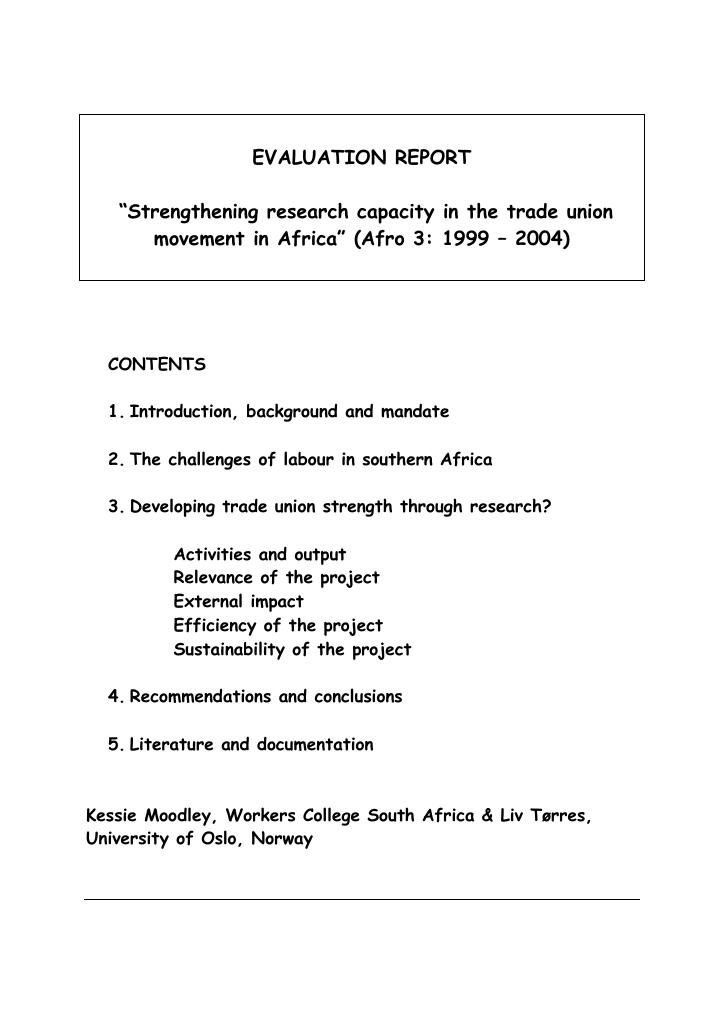
Strengthening research capacity in the trade union movement Evaluation Report
Background The programme was initiated by ICFTU-AFRO in 1998 as an extensionof earlier research programmes carried out by ICFTU. A limited group ofcountries in Southern and Eastern Africa were chosen, all of them existing co-operating partners of LO-Norway. Purpose/objective The objectives have been to increase the knowledge and union capacity incollective bargaining as well as policy development on various issues. Due to effects of globalisation and the World Bank and IMFs structural adjustmentprogrammes there are needs for the unions to elaborate new strategies on howto survive and how to protect the workers rights. Methodology The evaluation team has conducted interviews with persons directly involvedin the programme. Some participants have been interviewed. Documents including activity reports and audited accounts have been carefully studied Key findings The overall findings of this evaluation are that the issues dealt with in thetraining have been relevant to the participating organisations. Participants have to a greater extent been able to represent the unions in negotiations an external meetings. This is due to increased knowledge on key trade union issues. Some of the participants in the programme have been permanently employed in the unions or been elected shop stewards.The weakness of the programme has been that the human and financial resources of the participating organisations have varied. The programme has to a great extend succeeded in Zambia and Uganda, but failed in Malawi. Only a few women have participated in the programme. A substantial amount of money has been spent on co-ordination of the programThe evaluation report is generally positive. The report recommends to narrowthe programme to handle only a few issues in future with emphasis on collective bargaining. A key proposal in the report is to strengthen the unions' capacity to negotiate. Equal training programmes in all countries hould have been elaborated.