

Romlig-temporal utvikling i kadaverfunn: Tap av beitedyr i forvaltningsområder og randsoner for rovvilt
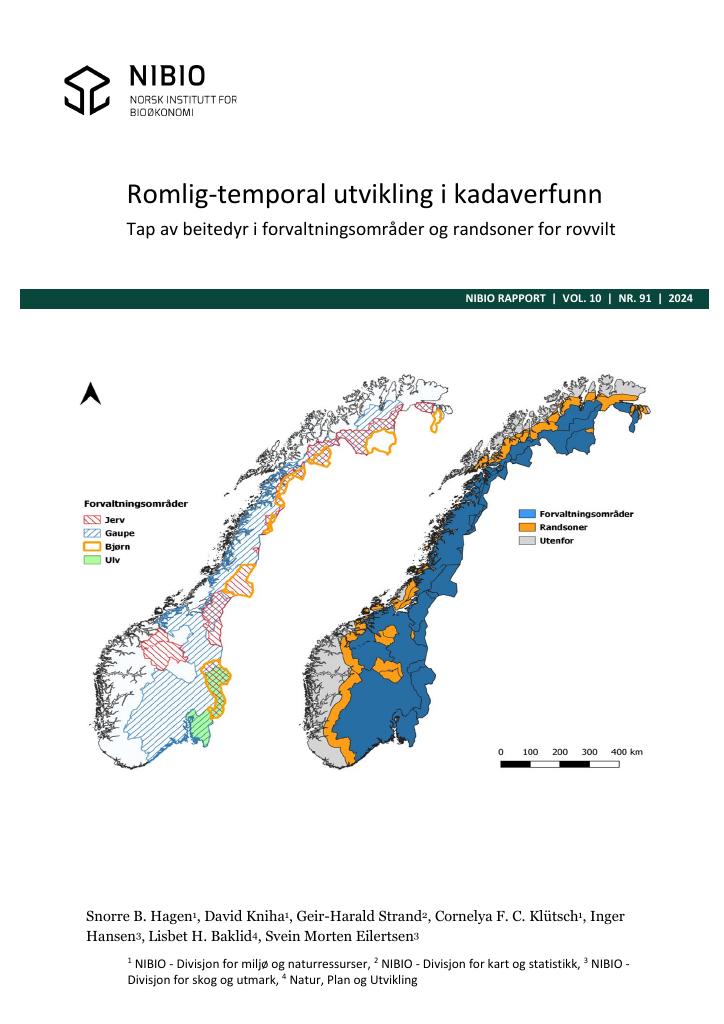
In Norway, grazing is a natural part of a sustainable use of rangeland, where coexistence with protected carnivores is a challenge. The twofold objective of Norwegian carnivore policy and management is that both grazing industries and predators must be considered and preserved at a sustainable level. This is pursued through area differentiation (i.e., zonation), with separate areas where predatory game and grazing animals respectively have priority. A consequence of this management regime is area challenges and marginal zone problems, which arise in the border areas between carnivore-priority and grazing-priority areas, where the occurrence of grazing animals and predators coincides. Especially in the border zone areas, there are therefore often conflicts between the two goals in large carnivore conservation policy and management. Commissioned by the Ministry of Agriculture and Food (LMD), the Norwegian Institute of Bioeconomy Research (NIBIO) has examined how the area-differentiated management regime that Norway practices affects the loss of sheep and reindeer. This has been done by studying spatial-temporal and seasonal variation and development in carcass finds of sheep and reindeer both inside and outside the predatory priority areas and adjacent marginal zones in Norway.
Publisert
Eier
Landbruks- og matdepartementet (LMD)
Utfører
NIBIO - Norsk institutt for bioøkonomi (Nibio)
Forfattere
Snorre B. Hagen, David Kniha, Geir-Harald Strand, Cornelya F. C. Klütsch, Inger Hansen, Lisbet H. Baklid og Svein Morten Eilertsen
Språk
Norsk (bokmål)