

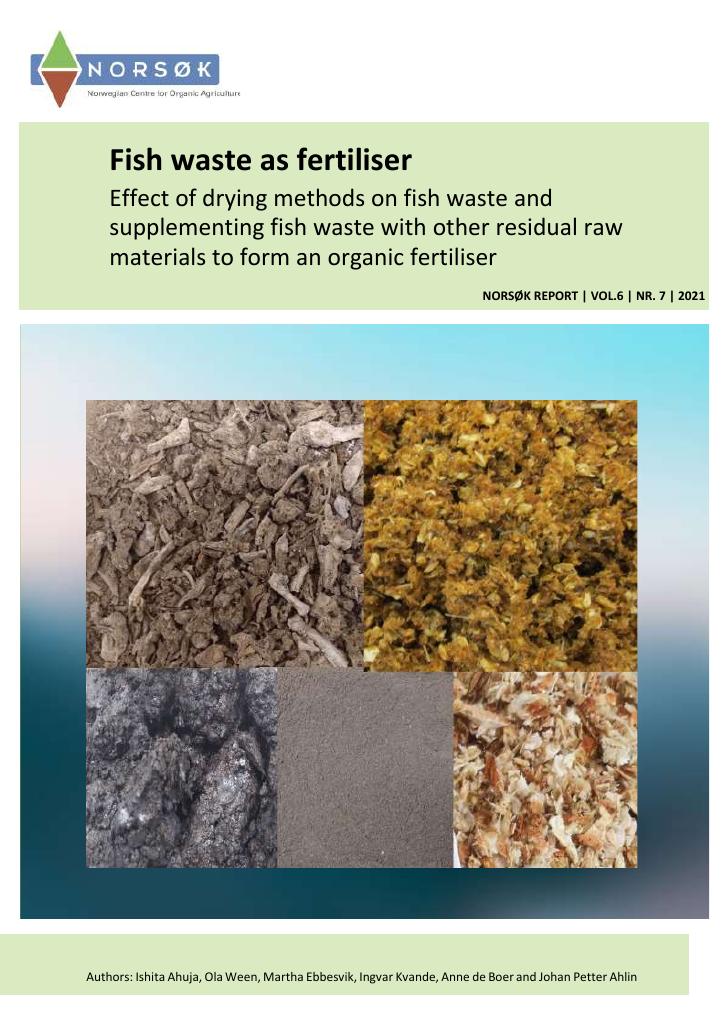
Fish waste as fertiliser Effect of drying methods on fish waste and supplementing fish waste with other residual raw materials to form an organic fertiliser
This report investigates how different drying methods affect fish waste (fish sediments and minced fish backs) and evaluates the potential of combining fish waste with other residual raw materials to produce an organic fertiliser. Laboratory drying experiments (cabinet drying at 25, 40 and 80°C with and without air circulation, freeze-drying, microwave) and chemical analyses (pH, total N, NH4-N, major nutrients, heavy metals) were performed. Cabinet drying with air circulation was most effective for moisture reduction, and drying method/temperature influenced pH and nitrogen fractions. Model calculations indicate mixtures of fish waste, algae fibre, bottom ash and crab shells with manure or commercial fertiliser can meet crop nutrient needs, but elevated heavy metal levels may restrict direct use.
Publisert
Eiere
Kunnskapsdepartementet (KD), Norges forskningsråd (NFR) og Møre og Romsdal fylkeskommune
Utførere
Møreforskning AS, Stiftelsen NORSØK og Tingvoll flis og varme as
Forfattere
Ishita Ahuja, Ola Ween, Martha Ebbesvik, Ingvar Kvande, Anne de Boer og Johan Petter Ahlin
Språk
Engelsk